
How long does it take for vinegar to kill weeds? With 45% concentrated vinegar on a warm sunny day, visible wilting begins within 2 to 6 hours and annual weeds fully collapse within 24 hours. The timeline depends on four variables: acetic acid concentration, weather conditions, weed type, and whether the foliage is dry at application. For the full application walkthrough, see the Vinegar Weed Killer guide.
What Is the Hour-by-Hour Kill Timeline?
Under ideal conditions - a warm sunny day, 45% concentrated vinegar applied directly to dry foliage - here is what the kill timeline looks like.
|
Time After Application |
What You Should See |
What It Means |
|
0 to 2 hours |
No visible change |
Acid working at the cellular level |
|
2 to 6 hours |
Wilting begins, leaves curl and yellow |
Desiccation underway, cell membranes breaking down |
|
6 to 12 hours |
Browning and collapse visible |
Annual weeds showing full surface dieback |
|
24 hours |
Annual weeds fully browned and dead |
Complete kill on shallow-rooted annuals |
|
24 to 72 hours |
Perennials showing surface dieback |
Root may still be alive - monitor for regrowth |
|
7 to 14 days |
Perennials may show new growth from root |
Second application required if regrowth appears |
These timelines apply to 45% concentrated vinegar. Standard 5% household vinegar is significantly slower and often fails to produce a complete kill on anything beyond the youngest seedlings.
What 4 Factors Affect How Fast Vinegar Kills Weeds?
Four variables determine whether vinegar kills weeds in 2 hours or 48. Concentration is the single most important.
According to PubChem (National Institutes of Health) - Acetic Acid, acetic acid disrupts plant cell membranes on contact, lowering pH and causing rapid moisture loss. The speed of this reaction scales directly with concentration. The EPA minimum-risk pesticide program under 40 CFR Part 152 recognizes acetic acid as an approved herbicide active ingredient.
Factor 1: Concentration of Acetic Acid. At 5%, surface burn on young weeds may appear within 24 to 48 hours but often fails to kill the plant entirely. At 45%, the same result happens in 2 to 6 hours. Jumping from 5% to 45% does not just make the product nine times faster - it changes the mechanism from surface cosmetic burn to genuine tissue destruction. For a full breakdown see the Vinegar Weed Killer guide.
Factor 2: Temperature and Sunlight. A bright sunny day at 80 degrees F produces visible results within 2 to 3 hours. An overcast day at 55 degrees F may take 12 to 24 hours and may not produce a complete kill. Application on a warm, sunny day is a functional part of the process, not just a suggestion.
Factor 3: Weed Type and Root Depth. Annual weeds with shallow root systems die quickly and completely. Perennial weeds show surface dieback on the same timeline but regrow from the root. For perennials, full suppression requires several weeks of repeat treatment.
Factor 4: Foliage Condition at Application. Morning dew, recent irrigation, or rain dilutes the product on contact, reducing effective concentration and adding 12 to 24 hours to the kill timeline - or causing a failed treatment entirely. Apply only to completely dry foliage.
Why Does Concentration Determine the Timeline?
Most vinegar weed killer disappointments come down to using the wrong product. NSF certification is the only independent verification that the concentration on the label matches what is in the bottle. Nature's Freedom 45% Concentrated Vinegar is NSF Certified to NSF/ANSI/CAN 60 for drinking water treatment chemicals - independently verified for formulation and purity. It is the only option in this category with that verification.
|
Brand |
NSF Certified |
Concentration |
Made in USA |
|
Nature's Freedom |
Yes - NSF/ANSI/CAN 60 |
45% |
Yes |
|
Calyptus |
No |
45% |
Yes |
|
Belle Chemical |
No |
45% |
Unknown |
|
Natural Armor |
No |
45% |
Unknown |
How Long Does Vinegar Take to Kill Different Weed Types?
Root depth is the primary variable determining kill speed across weed types.
|
Weed Type |
Time to Visible Results |
Time to Full Kill |
Notes |
|
Annual weeds (crabgrass, chickweed) |
2 to 6 hours |
12 to 24 hours |
Reliable single-application kill at 45% |
|
Young dandelions (first season) |
4 to 8 hours |
24 to 48 hours |
Crown damage likely - monitor for regrowth |
|
Established dandelions (deep taproot) |
6 to 12 hours |
Surface only |
Root survives - 2 to 4 applications needed |
|
Moss on hard surfaces |
4 to 12 hours |
24 to 48 hours |
Reliable kill - brush away dead material after |
|
Grass in pavement cracks |
2 to 6 hours |
24 hours |
High kill rate on confined root systems |
|
Bindweed or creeping perennials |
6 to 12 hours |
Surface only |
Regrowth likely - persistent treatment required |
What Should You Do If Weeds Are Still Green After 48 Hours?
If treated weeds are still visibly green and healthy at 48 hours, one of four things happened. For a full re-treatment guide, see How to Kill Weeds With Vinegar.
• Concentration was too low. If you used 5% household vinegar or a heavily diluted solution, there was not enough acetic acid to complete the kill. Re-treat with undiluted or lightly diluted 45% concentrated vinegar.
• Rain or dew washed the treatment off. Check whether there was moisture on the foliage at time of application or rainfall within a few hours afterward. Re-treat on a dry day with a completely dry forecast.
• Application missed the foliage. If acid landed mostly on soil rather than leaves and stems, the plant was never meaningfully contacted. Re-treat with direct foliage saturation.
• The weed is a deep-rooted perennial. Some perennials are slow to show surface dieback. If leaves look stressed but the plant has not fully collapsed at 48 hours, evaluate again at 72 hours before re-treating.
How Long Until Treated Areas Are Safe for Pets and Children?
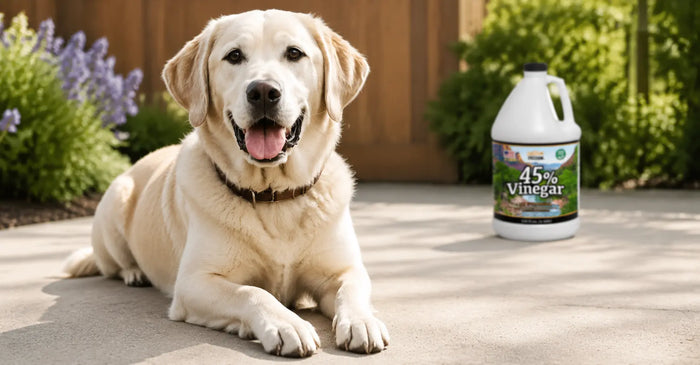
Treated outdoor surfaces are safe for pets once fully dry - typically within one to three hours outdoors.
Acetic acid dissipates from surfaces rapidly once dry. Unlike glyphosate-based herbicides, which bind to soil and persist for days to weeks, acetic acid does not linger. The EPA Safer Choice program recognizes acetic acid's favorable safety profile compared to conventional herbicide alternatives. A pet walking across a treated driveway is safe to do so by afternoon if the surface was treated in the morning and is completely dry. Learn the 45% vinegar complete reference.
For households managing yard odor alongside weed treatment, Nature's Freedom also offers an Outdoor Pet Odor Eliminator designed for the same outdoor surfaces.
The Fastest Kill Timeline Starts with the Highest Verified Concentration
If you want to know how long it takes for vinegar to kill weeds and get the answer in hours rather than days, the answer starts with using 45% acetic acid on a warm sunny day. Nature's Freedom Concentrated Vinegar is NSF Certified to NSF/ANSI/CAN 60 for drinking water treatment chemicals, made in the USA, and built to deliver browning within hours - not a week of retreatment. Order the 45% Concentrated Vinegar - 1 Gallon. Browse the full concentrated vinegar collection, or contact the Nature's Freedom team with questions.
Frequently Asked Questions: How Long Does Vinegar Take to Kill Weeds?
1. How fast does vinegar kill weeds compared to Roundup?
Vinegar at 45% is faster for visible surface results. It begins wilting weeds within 2 to 6 hours. Glyphosate typically takes 1 to 3 days to show visible results, though it ultimately kills the root system. Vinegar acts fast on contact but does not reach roots the way glyphosate does.
2. Why did my vinegar treatment take more than 24 hours to work?
The three most likely reasons are low concentration (5% instead of 45%), overcast or cool weather slowing the desiccation process, or wet foliage at the time of application. All three reduce speed and completeness of the kill. Re-treat on a warm sunny day with 45% concentrated product applied to completely dry leaves.
3. Does vinegar kill weeds faster in summer than spring?
Yes. Higher temperatures and stronger sunlight in summer accelerate the desiccation effect. A treatment applied on a 90 degree F July afternoon shows results in 2 to 3 hours. The same treatment on a 55 degree F overcast April morning may take 18 to 24 hours or produce incomplete dieback.
4. How long does it take for vinegar to kill grass?
With 45% concentrated vinegar on a warm sunny day, grass shows browning and collapse within 6 to 24 hours depending on maturity and root depth. Grass in confined spaces like pavement cracks typically dies faster than established turf with deep root systems.
5. Should you water the area after applying vinegar?
Do not water treated areas for at least 48 hours after application. Irrigation dilutes and washes away the acid before it finishes working, significantly extending the kill timeline or causing a failed treatment. Wait until weeds show clear dieback before resuming any watering near treated zones.
6. How long until you can replant after treating weeds with vinegar?
Acetic acid dissipates rapidly in soil and does not accumulate the way synthetic herbicides do. In most cases, treated areas are safe to replant within 24 to 48 hours. For heavy applications to bare soil, waiting 72 hours before planting is a reasonable precaution.
Key Takeaways
• With 45% concentrated vinegar on a warm sunny day, visible wilting begins within 2 to 6 hours and annual weeds fully collapse within 24 hours.
• The four main factors affecting kill speed are: concentration, temperature and sunlight, weed type and root depth, and foliage condition at the time of application.
• 5% household vinegar is significantly slower than 45% concentrated vinegar and often fails to produce a complete kill - which is why many people assume vinegar does not work.
• Deep-rooted perennial weeds show surface dieback on the same 24 to 72 hour timeline but regrow from the root. Multiple applications over several weeks are required for suppression.
• Nature's Freedom is the only concentrated vinegar brand certified to NSF/ANSI/CAN 60 for drinking water treatment chemicals - its concentration claim is independently verified, unlike Calyptus, Belle Chemical, and Natural Armor.
• Treated outdoor surfaces are safe for pets once fully dry, typically within 1 to 3 hours of application.